Cart
0
Most "best leather bag" lists do the same thing. Ten products, ten photos, a line or two of copy under each, done. What they skip is the actual problem you're trying to solve: fitting a 15-inch laptop, a folder of A4 documents, a charger, a mouse, your wallet and keys, and still walking out the door without your shoulder aching by lunchtime.
That's a fit problem before it's a shopping problem. So instead of just naming bags, this guide walks through how to figure out what you actually need from a leather bag for laptop and documents, then points you toward the styles that deliver it.
Why This Is Harder Than It Looks
A laptop bag alone is easy. So is a document folder. The trouble starts when one bag has to carry both, plus the smaller stuff you don't think about until you're rummaging for it on a train platform. A good leather office bag has to solve four problems at once: protect an expensive laptop, keep A4 papers flat and creased, organize small accessories so you're not digging around for a charger, and still look like something you'd carry into a client meeting.
Cheap bags usually solve one of these and ignore the rest. You'll find laptop sleeves with no document pocket, or document folders with a laptop compartment that's really just a flat pouch with zero padding. The right bag treats all four as equally important, not as an afterthought bolted onto a laptop compartment.
Start With Laptop Size and Protection
Before anything else, know your laptop's actual dimensions, not just the screen size marketing number. Laptop screen size alone doesn't tell you the exact width, height and thickness, so check those measurements against the bag's compartment before you buy. A bag rated for your screen size but with no padding room can still feel tight the moment you try to zip it.
Look for a few specific things:
- A padded, separate compartment. The laptop sleeve should be its own zippered or Velcro-secured section, not sharing space with documents or cables. If your charger cable can touch your laptop's screen while it's in the bag, that's a design flaw, not a minor inconvenience.
- Structured base and sides. Leather bags with a stiffened base (sometimes reinforced with a foam or board insert) hold their shape even when half-empty, which keeps the laptop compartment from folding in on itself.
- A bit of size buffer. A compartment built exactly to your laptop's size looks neat in product photos but makes sliding the laptop in and out a two-hand job every time. Leave enough clearance for easy insertion and removal, without making the compartment so loose that the laptop shifts around inside it.
Leather grade plays a role here too. Higher-quality leather, combined with good construction and reinforcement, can help a bag maintain its structure over time, so it doesn't sag around the laptop the way a thinner, poorly built compartment might.
A4 Documents Deserve Their Own Compartment
This is the part most laptop bags get wrong. A4 sheets, folders, and notebooks need a flat, wide pocket that doesn't bend them at the corners. If your bag's "document pocket" is really just the space behind the laptop sleeve, your papers will pick up creases from the laptop's edge.
What actually works:
- A dedicated flat pocket sized for A4, ideally with a magnetic or zip closure so papers don't slide out when the bag is set down at an angle.
- Enough rigidity in the panel behind the pocket that a stack of ten or fifteen sheets doesn't bow the whole bag out of shape.
- A little extra depth if you regularly carry a folder or a slim binder, not just loose sheets.
If you're the sort of professional who's still printing contracts, reports, or signed documents, this compartment matters as much as the laptop sleeve. Don't let it be an afterthought in the product description.
Charger, Mouse, and the Small Stuff That Gets Lost
Every professional carries a small pile of accessories that don't have an obvious home: a charging brick, a cable, maybe a wireless mouse, a pen, a USB drive. Thrown loose into the main compartment, these things end up tangled with each other or scratching against the laptop.
A professional leather bag built for daily use should have a front organizer panel with a few small pockets and pen slots. It sounds like a small detail, but it changes how the bag actually feels to use. You stop patting down every pocket looking for your charger before a meeting.
Some bags go further with a padded accessory pouch that clips inside the main compartment. That's worth having if you carry a mouse or other small hardware regularly, since keeping it contained means less rattling around near the laptop compartment.
Wallet, Keys, and Personal Items
The last category is the one people forget to plan for until they're standing at a coffee counter, holding their laptop bag open, trying to find their wallet with one hand. A quick-access pocket, ideally at the top or on the outer flap, is worth more than it seems on paper.
Keys specifically benefit from a small clip-in loop inside the bag. It stops them from sinking to the bottom of the main compartment and scratching the laptop sleeve's lining every time the bag shifts.
If you carry a phone you want out of your pocket during the day, check whether the bag has a slim outer pocket sized for that too. It's a small thing, but it's the difference between a bag that was designed around how people actually move through a day and one that was designed around a product photo.
Backpack vs Briefcase vs Messenger: Which Suits You
This is the decision most people spend the least time on, and it probably matters more than the leather grade.
Backpacks distribute weight across both shoulders, which matters if you're commuting on foot, on a bike, or through crowded transit. A well-built leather laptop backpack can carry a laptop, documents, and accessories comfortably, and it leaves both hands free. The tradeoff is that they read more casual than a briefcase, which may or may not fit your workplace.
Briefcases are the classic choice for client-facing roles, courtrooms, or offices with a formal dress culture. They hold their shape well and look deliberate rather than thrown-together. The downside is obvious the moment you're not carrying just a laptop and folder. Once you add a water bottle, a jacket, or a second bag, a single-handle briefcase starts to feel like the wrong tool.
Messenger bags sit somewhere in between. Single-shoulder carry, generally more casual than a briefcase but more structured than a backpack. They work well if you're moving in and out of meetings often and want quick access without setting the whole bag down. The catch is the weight sits on one shoulder, which adds up if you're walking any real distance with a laptop inside.
None of these is objectively better. It genuinely depends on your commute, your dress code, and how much you're carrying beyond the basics. If you're commuting on foot or by bike most days, a backpack usually wins on comfort. If you're mostly in a car or cab and want to look sharp walking into a meeting, a briefcase does that job better than anything else.
Daily Office Use vs Short Business Travel
A bag that works perfectly for a nine-to-five office day can fall short the moment you add an overnight trip. If you travel for work even occasionally, it's worth checking two things before you buy.
First, does the bag have a trolley sleeve on the back, the strap that slides over a wheeled suitcase handle? This sounds minor until you're at an airport managing a laptop bag, a suitcase, and a coffee at the same time.
Second, is there enough flexibility in the main compartment to fit a change of clothes or a small toiletry pouch for a one-night trip, without crushing the laptop compartment? You don't need a bag built for a week away. You just need one that doesn't fall apart the moment your Tuesday turns into a Tuesday-and-Wednesday trip.
If business travel is a regular part of your week, it may be worth having two bags rather than forcing one to do everything: a slimmer daily bag for the office, and a slightly larger one for trips. But for most people, one well-chosen bag that flexes a little is enough.
Capacity and Compartments: More Isn't Always Better
It's tempting to assume the bag with the most pockets wins. In practice, too many compartments make a bag harder to use, not easier. You end up with three places a pen could be and no memory of which one you used last time.
A better approach is to count what you actually carry on a typical day: laptop, charger, one or two documents or a folder, wallet, phone, keys, maybe a water bottle. Then look for a bag with exactly enough compartments to give each of those a fixed home, not a dozen extra pockets you'll never fill.
Overall capacity matters too, but bigger isn't automatically better. A bag with more room than you need tends to shift and slump as you walk, since nothing inside is holding its shape. A bag sized closer to what you actually carry sits and moves better on your body.
Comfort and Carrying Options
Leather bags can be heavier than many fabric alternatives, depending on the leather thickness and construction, so weight distribution becomes important once you add a laptop and everything else. A few things worth checking before you buy:
- Strap width and padding. A narrow, unpadded strap on a loaded leather bag will dig into your shoulder within an hour. Wider straps with some padding or a woven backing spread the load.
- Adjustability. You want a strap that adjusts easily with one hand, especially for a messenger or crossbody style you're taking on and off through the day.
- Handle comfort for briefcases. A leather-wrapped top handle is more comfortable over a short walk than bare metal or an unpadded strip of leather.
- Back panel padding for backpacks. Look for some structure and breathability against your back, particularly if you're commuting somewhere warm.
None of this shows up clearly in product photos, which is part of why so many people end up with a bag that looks right online and feels wrong after two weeks of daily use.
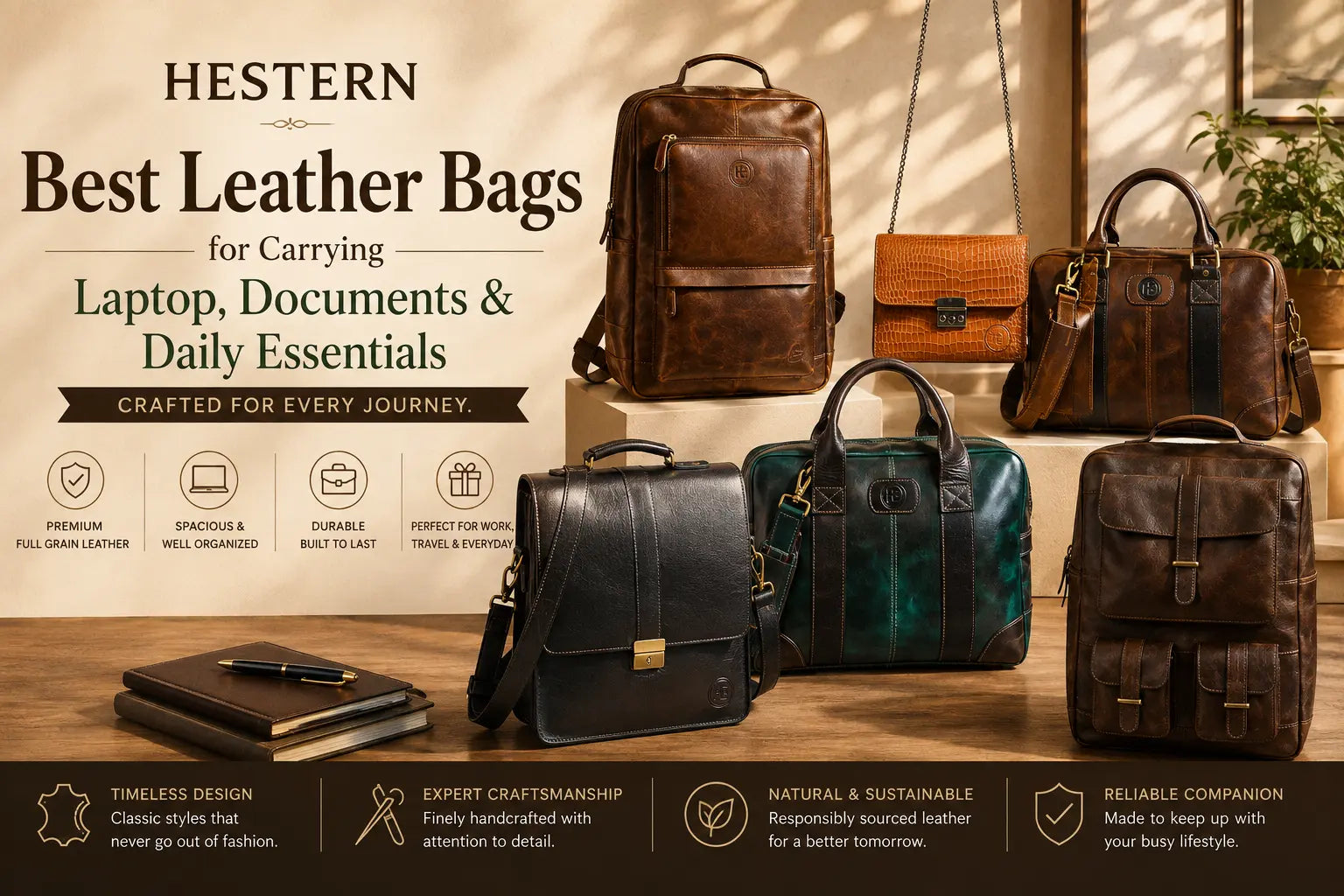
Best Leather Bags for Laptop and Documents: 5 Picks by Use Case
Once you know what you're looking for, it helps to see it against real options rather than a checklist. Here are five picks from Hestern's range, each suited to a different way of working.
Best for daily office carry: Heritage Buffalo Pure Leather Laptop Bag – Brown Colour A structured, briefcase-style bag in full-grain buffalo leather with a separate padded laptop section and a proper document compartment behind it. This is the shape most people picture when they think "office bag," and it holds that structure well through daily use.
Best for laptop plus a heavier document load: Heritage Buffalo Pure Leather Laptop Bag – Rich Green Same build as the brown version, in a deeper green finish, and a strong pick if you regularly carry a bulkier stack of files or a folder alongside the laptop. The flat document panel keeps papers from bending at the corners.
Best for commuting on foot or by bike: Hestern TerraLux Leather Backpack – Expresso Brown A backpack-style option in buffalo leather with adjustable straps, built for anyone who wants both hands free during the commute. It carries a laptop and documents without leaning entirely on one shoulder.
Best for short business travel: Alpine Vintage Leather Laptop Backpack – Brown Colour A rugged, full-grain buffalo leather backpack with room to spare beyond just a laptop and folder, useful if a work day occasionally turns into an overnight trip.
Best for quick meetings and minimal carry: Obsidian Executive Leather Sling Bag – Tan Colour A single-shoulder sling in full-grain buffalo leather, sized for a slim laptop, a phone, a wallet, and not much else. Good for anyone moving between short meetings who doesn't want to carry a full-size bag around all day.
Bringing It Together
There's no single "best" leather bag for everyone, because the right one depends on what's actually in your bag on a normal Tuesday, not what looks good in a flat-lay photo. Someone who commutes by bike with a laptop and a folder needs something completely different from someone flying out for client meetings twice a month.
What stays constant is the checklist: a properly padded, separate laptop compartment, a real A4 document pocket that won't crease your papers, an organizer for chargers and small accessories, a quick-access spot for your wallet and keys, and a carry style that matches how you actually move through your day.
If none of the five picks above are quite right, Hestern's full leather laptop bags collection is built around exactly this kind of daily use, with padded laptop compartments and proper document sections rather than a single catch-all pocket.
Frequently Asked Questions
1. What size leather bag do I need for a 15-inch laptop? Look for a compartment listed for 15.6 inches, since actual laptop widths vary even within the same screen size category. A small buffer of extra room, properly padded, makes the laptop easier to slide in and out without forcing it.
2. Can a leather laptop bag also hold A4 files and documents without damaging them? Yes, as long as it has a dedicated, flat document pocket separate from the laptop compartment. Bags that mix documents and laptop in the same space tend to crease papers at the corners over time.
3. Is a leather backpack or a briefcase better for daily office use? It depends on your commute and dress code. Backpacks are more comfortable over distance and free up your hands, while briefcases look more formal and suit client-facing or courtroom settings. Messenger bags sit in between.
4. How much does a good leather laptop and document bag usually cost in India? Genuine leather bags with proper laptop padding and a document compartment typically start in the mid-thousands and go up depending on the leather grade and hardware. Full-grain and top-grain leather are generally positioned as more durable, premium materials, though actual lifespan also depends on construction quality and how well the bag is cared for.
5. Are leather bags heavy to carry with a laptop inside? Leather does weigh more than synthetic materials, but a well-padded, wide strap or handle makes the difference less noticeable. Backpacks generally distribute laptop weight better than a single-shoulder bag for anyone carrying it a long distance.