Cart
0
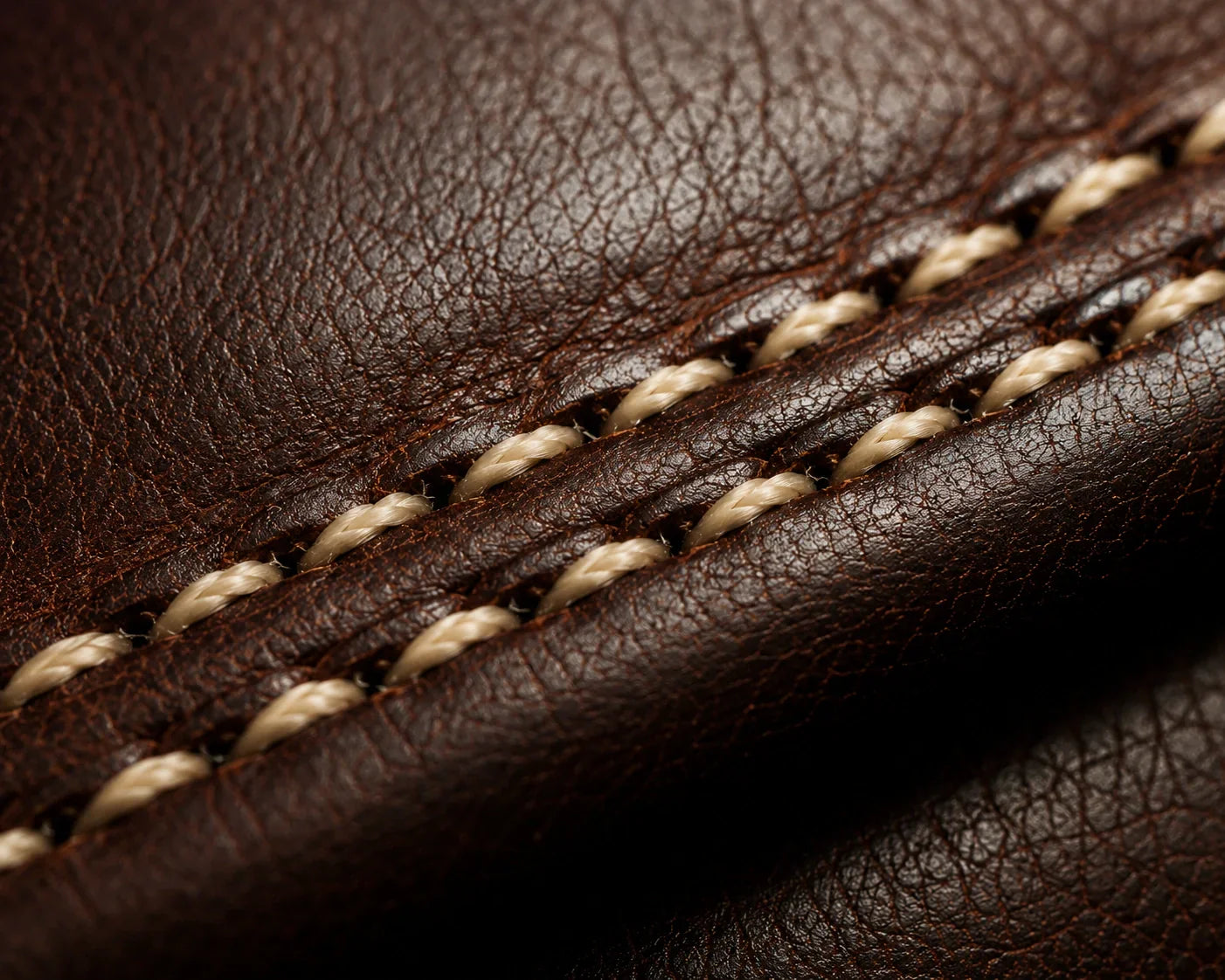
The fastest way to tell handmade leather bags from machine-made ones is to check five things: the stitching pattern (saddle stitch vs lock stitch), the edge finishing, the grain consistency, the symmetry of the build, and the weight and density of the leather. Handmade leather bags use thicker thread, slightly uneven stitches, hand-burnished edges, natural grain variation, and full-grain hide. Machine-made bags show perfectly identical stitches, glued or painted edges, uniform texture, and often thinner leather. Five checks. Two minutes. Almost impossible for a fake to pass all of them.
There's a reason a handmade leather bag costs more, ages better, and ends up outliving the laptop inside it. The skill is in the construction, not the branding stitched onto the front.
But here's the catch in 2026: every brand calls itself "handcrafted." The word has been stretched into marketing copy on bags that were never touched by a craftsman. So the only reliable way to know what you're buying is to learn what to look for yourself.
Why It Matters Before You Spend On Just Any Leather Bag
A quality leather bag is one of the few accessories where the way it's made directly decides how long it lasts.
Handmade leather bags reinforce stress points by hand—handles, strap joints, base corners. These are the exact places cheaper machine-made leather bags fail first. The difference shows up at year two, not week one, which is what makes it so easy to miss at the time of purchase.
The five checks below catch the difference at the counter, before it becomes a buying regret.
1. The Stitching — Saddle Stitch vs Lock Stitch
Stitching is the single most reliable signal. Once you know what to look for, you can identify a hand stitched leather bag from across the room.
Saddle stitch (handmade) uses two needles and one thread, looped through each hole in a figure-eight pattern. If one stitch breaks somewhere along the seam, the rest of the line holds. The stitches sit slightly raised, slightly angled, and the back of the seam looks just as clean as the front.
Lock stitch (machine-made) uses one needle from above and a bobbin below. The stitches sit perfectly flat and identical. If one stitch breaks, the line unravels in both directions.
What to check:
- Look at the underside of a seam. Saddle stitching looks identical front and back. Lock stitching looks tidy on top and messier underneath.
- Look for slight irregularity. Hand saddle stitching is consistent in spacing but never machine-perfect in angle. Perfectly identical stitches on every seam = it was sewn by a machine, regardless of what the tag claims.
- Look at high-stress areas—handle attachments, strap bases, corners. Genuine handmade leather bags reinforce these with extra hand stitches. Machine-stitched leather bags rely on the same single pass everywhere.
Hestern's full grain leather bags are hand-stitched at every load-bearing seam, which is exactly why they hold their shape through years of daily carry.

2. The Edges — Hand-Burnished vs Painted
Edge finishing is the second-fastest tell. Most buyers ignore the edges entirely. That's why brands get away with cutting corners here.
Hand-burnished edges (handmade): The cut edge of the leather is sanded smooth, sealed with wax or gum tragacanth, then rubbed with a tool until the fibres compress into a smooth, glossy band that's the same colour as the leather itself.
Painted edges (machine-made): The cut edge is coated in a thin layer of acrylic edge paint. It looks neat at first, but the paint cracks, chips, and peels within a year or two—revealing the rough raw fibre underneath.
What to check:
- Run a fingernail along the edge of the bag. Hand-burnished edges feel firm and smooth. Painted edges feel slightly plasticky and can sometimes be peeled at the corner.
- Look for colour match. Burnished edges blend into the leather; painted edges sit on top of it.
- Check the edge inside the bag where you'd never normally look. Mass-produced bags often skip edge work in hidden spots. Handmade leather bags finish them anyway.

3. The Grain — Natural Variation vs Uniform Texture
The leather itself tells you whether the bag was built around the hide or the hide was forced to fit the bag.
Handcrafted leather bags use full-grain leather. The top layer of the hide is left intact, so the natural grain, pores, scars, and texture variations are visible across the bag. Two panels on the same bag won't look identical—because no two parts of an animal's hide are identical.
Machine-made leather bags often use corrected-grain or bonded leather. The surface is sanded down, embossed with a fake grain pattern, and painted to look uniform. Every panel looks the same. Every bag in the store looks the same.
What to check:
- Look at three or four points on the bag. Real full-grain leather will show pore variation between them. Embossed leather will show identical repeating patterns.
- Tilt the leather under light. Natural grain reflects unevenly; embossed grain reflects in a regular, almost screen-printed way.
- Press your thumbnail gently into a less visible spot. Full-grain leather marks lightly and recovers. Bonded leather creases sharply or doesn't recover at all.
For a deeper read on why the hide matters as much as the construction, this Hestern piece on buffalo leather vs goat leather is worth a few minutes.

4. The Symmetry — Subtle Imperfection vs Machine Precision
This one feels counterintuitive at first: too much perfection is a red flag.
A handmade leather bag is built by a person, panel by panel. There will be tiny variations between the left and right sides. A hand-finished edge will have a slightly different sheen at one corner. A grain mark on one strap won't appear on the other.
A machine-made bag is built from identical dies and identical assembly steps. Every unit is a clone of the next. Perfect symmetry. Perfect repetition. Perfectly soulless.
What to check:
- Compare matching elements—handles, side panels, pocket placements. Slight variation = handmade. Mirror-image precision = machine.
- Look at the brand's product photography. If every "handmade" bag in the catalogue looks completely identical to the one you're holding, the "handmade" claim is doing a lot of marketing work.
- Embrace the small imperfections. A subtle mark in the leather or a slight irregularity in the burnish isn't a flaw—it's proof a person made the bag.

5. The Weight and Density — Solid Hide vs Thinned Leather
Pick the bag up. Hand-made leather bags feel heavier than they look. There's a good reason.
Quality handmade leather bags use thick, full-grain hide—often 1.8mm to 2.5mm in panel thickness. That gives the bag its structural memory, its drape, and its ability to hold shape over a decade of carrying. The leather has actual heft because there's actual leather in it.
Machine-made leather bags routinely use thinner leather—often 0.8mm to 1.2mm—or split leather backed with a layer of fabric or polymer to fake thickness. They feel light. They also collapse on the floor when you set them down.
What to check:
- Heft the bag empty. A premium leather bag feels reassuringly solid, even when empty.
- Press the side panel between thumb and finger. Thick full-grain leather pushes back. Thinned or bonded leather feels squishy or compresses easily.
- Look at the cut edge. Real, thick hide shows a dense, fibrous cross-section. Bonded leather shows visible layers or a fabric backing.

Are Handmade Leather Bags Worth the Price?
The short answer is yes, if longevity matters to you.
A handmade full-grain leather bag costs more upfront. Then it lasts decades, develops a personal patina, and can be repaired instead of replaced. A machine-made bag in the same category usually needs replacing inside two or three years.
Run the cost-per-year math and the handmade bag is almost always cheaper. The price tag just hides the savings.
The Heritage Buffalo Pure Leather Laptop Bag is a straightforward example of this. Full-grain buffalo leather, padded laptop compartment up to 15.6", antique brass hardware, built for daily use and business travel. It's currently on sale at ₹ 6,499.00 down from ₹ 10,832. A bag that will still be in your rotation a decade from now, at under ₹ 7000.
That's the math working in your favour.

FAQs
Q: Are handmade leather bags really stronger than machine-made ones?
A: Yes, especially at load-bearing seams. Saddle stitching survives a broken stitch; machine lock stitching unravels. Reinforced handles and strap joints are also far more durable on handmade bags.
Q: Why are handmade leather bags more expensive?
A: Time, skill, and material. A handmade bag can take 8–20+ hours of artisan labour and uses thicker full-grain hide. Machine-made bags are produced in minutes from thinner, often corrected-grain leather.
Q: How long do handmade leather bags last?
A: With basic care, a quality handmade full-grain leather bag lasts 10–15 years and often longer. Many become heirloom pieces.
Read More
- Leatherette vs Real Leather: How to Spot Fake Leather Bags
- Buffalo Leather vs Goat Leather: Which Lasts Longer
Hestern Bestsellers
- Executive Heritage Leather Laptop Bag — hand-stitched full-grain buffalo briefcase, built to age into character
- Men's Leather Duffle Bag - Premium Full-Grain Buffalo Leather for durability and a refined vintage appearance
- Women Tote Bags - Crafted for sophisticated style, day-to-day utility, and enduring leather quality.